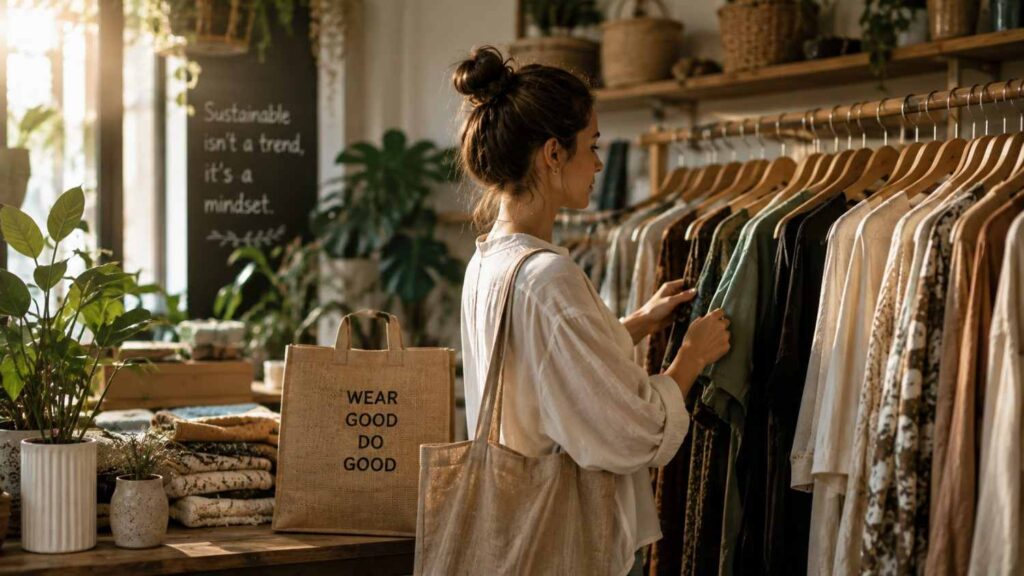
Which brands stand out most?
Patagonia, Pact, Reformation, EILEEN FISHER, tentree, and Nudie Jeans stand out because each provides identifiable evidence in an area that matters to responsible fashion. Patagonia has developed strong repair and resale infrastructure alongside material improvements. Pact focuses heavily on organic cotton basics, while Reformation makes product-level environmental information more visible for customers buying dresses, denim, and trend-conscious fashion.
EILEEN FISHER is especially notable for circularity because its Renew program gives previously owned garments another route through resale, donation, or remaking. tentree combines preferred materials with environmental restoration initiatives and impact reporting. Nudie Jeans takes a practical approach to sustainable denim by combining organic cotton with a repair system designed to keep jeans wearable for longer.
These brands should not be viewed as identical or universally perfect. Their strongest areas differ, and the right choice depends on the item being purchased. A shopper looking for technical outerwear will have different requirements from someone buying underwear, office clothing, or denim. The most useful comparison therefore matches documented sustainability practices with the product category and the customer’s real needs.
What should shoppers prioritise?
Shoppers should first prioritise garments they genuinely need and expect to wear regularly. Materials and certifications are important, but product lifespan also matters. A responsibly made garment that is worn repeatedly for several years can offer more practical value than an environmentally marketed item that is purchased impulsively and quickly replaced. Versatility, fit, quality, comfort, and repairability should therefore be considered alongside fibre choice.
The next priority is evidence. Product descriptions should explain what the item is made from rather than rely on vague phrases such as “green fabric” or “conscious materials.” Look for specific percentages, recognised standards, manufacturing information, care instructions, and clear environmental claims. Brands that publish supplier details, progress reports, repair policies, or take-back information make it easier for consumers to judge whether sustainability is embedded within the business.
Finally, shoppers should think about circularity. The Ellen MacArthur Foundation identifies practices such as repair, resale, rental, remaking, and longer product use as important parts of a circular fashion economy. From a consumer perspective, this means a better purchase is not simply one made from a preferred material. It is one that can remain useful, be maintained, repaired, transferred to another owner, or responsibly handled after its first period of use.
The Best Sustainable Fashion Brands to Know in 2026
Finding the best sustainable fashion brands requires more work than choosing a company with green packaging or a sustainability page. Fashion brands now regularly use words such as “responsible,” “eco-conscious,” “natural,” and “planet-friendly,” but these terms can mean very different things. A stronger evaluation looks for measurable evidence about materials, manufacturing, labour practices, environmental goals, product durability, and what happens to garments after the original owner stops using them.
Fashion also has an impact at several stages of the value chain. Raw fibres must be grown, extracted, or manufactured. Those fibres are processed, dyed, cut, sewn, packaged, transported, sold, washed, and eventually reused, recycled, donated, or discarded. UNEP has highlighted the significant environmental footprint associated with fashion and textiles, which is why focusing on only one improvement, such as recycled packaging, rarely provides a complete picture of a company’s performance.
This guide takes a practical approach. Instead of declaring one brand completely sustainable, it identifies companies with documented strengths and explains what those strengths mean for shoppers. You will also learn how to recognise credible certifications, avoid greenwashing, compare product-level claims, and build a wardrobe around durability and long-term use. The goal is to make sustainable fashion easier to understand for beginners while providing enough detail for readers who want to evaluate brands more critically.
What Makes a Fashion Brand Truly Sustainable?
A fashion brand becomes more credible when sustainability is integrated across several areas of the business instead of being limited to a small collection or marketing campaign. One recycled T-shirt or paper shipping envelope may be a positive improvement, but it does not explain the environmental and social performance of an entire company. A meaningful assessment examines materials, processing, manufacturing, labour conditions, emissions, product longevity, waste reduction, and the company’s responsibility after a garment has been sold.
Independent fashion coverage also highlights material choices, circular production, and reduced-impact practices as useful signals when assessing sustainable fashion brands.
Strong sustainable clothing brands usually provide multiple forms of evidence. These may include recognised textile certifications, organic or recycled materials, transparent supplier information, manufacturing standards, climate reporting, repair services, resale programs, garment take-back, and detailed sustainability reports. Each indicator answers a different question. Materials tell us what a product contains, while supply-chain information helps explain how and where it was produced. Repair and resale policies tell us whether the company considers product lifespan after the initial transaction.
Environmental sustainability and ethical production must also be considered together. A garment made from organic cotton may still raise questions if working conditions are poorly documented. Likewise, a highly transparent factory cannot remove the environmental concerns associated with every fibre or manufacturing process. The most responsible fashion companies work across several dimensions at once. Consumers do not need to demand perfection, but they should expect specific evidence, measurable progress, and honest communication about areas that still need improvement.
| Sustainability Factor | What to Look For | Strong Evidence |
|---|---|---|
| Responsible Materials | Organic cotton, recycled fibres, natural fibres, responsibly sourced materials | Specific fibre percentages, material policies, recognised textile standards |
| Certifications | Independent standards covering materials, production, or labour practices | GOTS, Fair Trade Certified, B Corp |
| Supply Chain Transparency | Information about factories, suppliers, sourcing, and manufacturing | Published supplier lists, factory information, sourcing policies |
| Worker Practices | Fairer wages, workplace standards, worker protections, responsible manufacturing | Independent certifications, supplier standards, social-impact reporting |
| Product Durability | Garments designed for repeated and long-term use | Durable construction, care guidance, repair services |
| Repair & Resale | Systems that keep clothing in use longer | Repair programs, resale platforms, trade-in schemes |
| Take-Back Programs | Options for returning unwanted garments | Clothing collection, recycling, reuse, or remaking programs |
| Environmental Reporting | Measurable information about environmental impacts | Carbon data, water footprint information, progress reports |
| Greenwashing Risk | Broad claims without supporting evidence | Specific claims backed by data, methodology, certifications, or documentation |
Responsible materials and recognised certifications
Material selection is an important starting point because fibres influence land use, water consumption, energy demand, chemical processing, durability, and recyclability. Consumers should look beyond generic descriptions and check the actual composition label. Organic cotton, recycled fibres, hemp, linen, responsibly sourced animal fibres, and certain manufactured cellulosic materials may provide advantages in different applications, although every material still has environmental trade-offs.
Third-party certifications can make material and manufacturing claims easier to evaluate. The Global Organic Textile Standard, or GOTS, applies to textiles made with certified organic fibres and includes environmental and social requirements throughout textile processing. Fair Trade certification can provide another layer of assurance within participating supply chains by assessing factories against defined production and worker-related standards.
Certification should never be treated as a complete sustainability score. A certified material does not automatically reveal whether a garment is durable, easy to repair, manufactured close to the customer, or designed for future recycling. It also matters whether the certification applies to the entire product or only one component. I recommend viewing recognised standards as strong supporting evidence while also considering construction quality, transparency, care requirements, repairability, and the company’s broader environmental strategy.
Labour practices and supply chain transparency
Sustainable fashion is not only about fibres, carbon emissions, or waste. Clothing is made by people, often across complex international supply chains involving farms, mills, dye houses, factories, warehouses, and logistics providers. Ethical fashion therefore requires meaningful consideration of working conditions, health and safety, wages, worker representation, production expectations, and the systems companies use to monitor and improve supplier performance.
Supply-chain transparency helps consumers understand whether a brand is willing to be accountable for these relationships. Useful information may include supplier lists, manufacturing countries, factory standards, codes of conduct, audit approaches, grievance systems, and progress reports. Transparency cannot guarantee perfect conditions, but it makes independent evaluation easier and reduces the distance between sustainability marketing and the realities of production.
Company-level certifications can add additional context. B Corp certification, for example, assesses businesses across wider areas of social, environmental, and governance performance. However, shoppers should avoid assuming that one company-level certification proves every individual product meets the highest possible standard. The strongest assessment combines broader corporate evidence with product information, factory disclosure, recognised textile standards, and a willingness to report both progress and unresolved challenges.
Durability, repair and circularity
Durability deserves more attention in sustainable fashion because extending the useful life of clothing can reduce the pressure to replace products frequently. A garment that uses responsible materials but quickly loses shape, tears, or becomes unusable creates a different outcome from a well-constructed item that can remain part of a wardrobe for years. Fabric quality, stitching, hardware, timeless styling, and realistic care requirements all influence longevity.
Repair also changes the relationship between customers and their clothing. A broken zipper, worn knee, missing button, or damaged seam does not always justify replacing an entire garment. Brands that provide repair instructions, repair centres, spare components, resale services, or trade-in programs make longer ownership more practical. They also show that the business has considered what happens after the initial sale.
Circular fashion expands this idea further by seeking to keep garments and materials in use through repair, reuse, resale, remaking, rental, and eventually responsible material recovery. Consumers can support circularity by buying fewer items, maintaining them properly, repairing damage early, and choosing companies that provide pathways beyond disposal. In practice, product longevity is one of the clearest ways to connect sustainable production with sustainable consumption.
Related Articles
How We Chose The Best Sustainable Fashion Brands
The brands in this guide were not selected simply because they are popular or frequently described as sustainable. The comparison focuses on companies that publish specific information about areas such as materials, environmental impact, certifications, circular programs, repair, supplier practices, or product-level measurement. Public documentation is important because sustainability claims become more useful when consumers can examine the evidence rather than relying entirely on advertising language.
Another consideration was specialisation. Fashion covers many categories, and a company that performs well in organic cotton basics may not be the best choice for technical outdoor clothing or denim. Ranking every brand with one universal score can hide these differences. Instead, the guide identifies what each company does particularly well. This makes the comparison more practical for shoppers who are trying to solve a specific wardrobe need rather than choose a single brand for every type of clothing.
The final factor was consumer usability. Sustainability information should be understandable enough to support a purchasing decision. Product descriptions, material breakdowns, repair policies, take-back instructions, impact reports, and recognised certification references are all more useful when they are clearly accessible. The table below summarises the main strengths of each company. It should be used as a starting point, followed by a product-level check before buying.
| Brand | Best For | Verified Sustainability Signals |
|---|---|---|
| Patagonia | Outdoor clothing | Preferred materials, organic virgin cotton, repair and Worn Wear |
| Pact | Everyday basics | Organic cotton, GOTS and Fair Trade relationships |
| Reformation | Trend-conscious fashion | Product-level carbon and water estimates through RefScale |
| EILEEN FISHER | Timeless wardrobes | Renew take-back, resale and remaking |
| tentree | Casual clothing | Preferred materials, restoration initiatives and impact reporting |
| Nudie Jeans | Denim | Organic cotton and repair support |
Patagonia: Best for durable outdoor clothing
Patagonia is frequently discussed in sustainable fashion because its approach extends beyond one environmentally focused collection. The company addresses material sourcing, manufacturing, repair, resale, and product longevity across a broad range of outdoor clothing. That wider approach is particularly relevant for technical apparel, where garments may contain several materials and components but are also expected to perform under demanding conditions for many years.
For its Fall 2025 line, Patagonia reported that preferred materials, including recycled inputs, represented 86% of its products by weight. The company also reported that the virgin cotton used in its clothing was grown using organic practices. These figures are useful because they relate to the broader product portfolio rather than a small promotional capsule. Patagonia also publishes information about environmental and social challenges within its supply chain.
Its Worn Wear program strengthens the brand’s circular approach by supporting repairs, used products, and trade-ins. For shoppers, this means product life can continue beyond the original purchase. Best for: outdoor jackets, fleece, workwear, technical layers, and clothing intended for repeated long-term use.
Pact: Best for organic cotton basics
Pact is particularly relevant to consumers searching for organic cotton clothing brands and simple everyday essentials. Products such as T-shirts, underwear, leggings, sleepwear, and casual basics are worn frequently, which makes material quality, comfort, fibre sourcing, and manufacturing standards important. Pact has built much of its sustainability positioning around organic cotton rather than treating it as a limited seasonal feature.
The company states that it works with recognised organisations and standards including Fair Trade USA and the Global Organic Textile Standard. Those references give shoppers clearer external benchmarks when evaluating claims around organic fibres and responsible production. GOTS provides requirements related to certified organic textile processing, while Fair Trade standards address participating production environments and worker-related considerations.
Pact’s main strength is not technical performance or high-fashion design. It is the ability to offer familiar wardrobe categories with a clearer focus on organic materials and responsible production signals. That makes the brand especially useful when replacing frequently worn essentials. Best for: underwear, T-shirts, leggings, sleepwear, casual layers, and comfortable organic cotton basics intended for regular use.
Reformation: Best for fashion-forward styles
Reformation occupies an important space within sustainable fashion because many consumers want contemporary clothing without moving entirely toward minimalist basics or outdoor brands. Its collections include dresses, denim, tops, occasionwear, and trend-focused pieces, making it particularly relevant to shoppers who want fashion-forward design while still considering environmental information as part of the purchase.
One of Reformation’s most recognisable tools is RefScale, which estimates carbon and water impacts associated with products and compares those estimates with conventional clothing benchmarks used within its methodology. Product-level measurement is valuable because it brings sustainability closer to the actual garment being purchased. Instead of seeing only a company-wide environmental promise, customers can consider impact information alongside fabric, design, fit, and price.
RefScale should not be interpreted as proof that every Reformation item has the lowest possible environmental footprint. Measurement always depends on methodology and available data. However, publishing product-level information creates more transparency than broad sustainability language alone. Best for: dresses, occasionwear, denim, contemporary women’s clothing, and shoppers seeking a stronger connection between fashion-led design and visible environmental information.
More Ethical Fashion Brands Worth Knowing
A strong sustainable wardrobe rarely needs to come from one company. Different clothing categories require different materials, construction methods, performance characteristics, and care routines. That is why it is useful to look beyond a short list of the most recognisable names. EILEEN FISHER, tentree, and Nudie Jeans each provide a different example of how a fashion business can address sustainability through circularity, preferred materials, environmental initiatives, or product repair.
EILEEN FISHER is especially relevant for customers interested in timeless garments and structured take-back programs. tentree appeals to shoppers looking for casual clothing combined with environmental restoration initiatives and public impact reporting. Nudie Jeans focuses on a category where durability matters greatly and makes repair a visible part of the ownership experience. These different models demonstrate that sustainability can be built into fashion businesses in several practical ways.
The broader lesson is that ethical fashion brands should not be reduced to one ranking system. One company may lead in repair while another provides stronger organic-fibre credentials or more accessible product-level environmental information. Consumers can make better decisions by identifying which factors matter most for the type of garment they need, then examining how well the brand addresses those priorities. This category-based approach is more useful than expecting one label to perform equally well in every area.
EILEEN FISHER: Best for circular and timeless clothing
EILEEN FISHER is a strong example of a brand combining relatively timeless design with a structured circular program. Its minimalist clothing is generally designed to work across seasons and wardrobes rather than depend heavily on fast-moving trends. This can support longer product use because customers may be less likely to consider a well-fitting, versatile piece outdated after a short period.
The EILEEN FISHER Renew program extends that approach by accepting previously owned garments from the brand and directing them toward resale, donation, or remaking. The company reports that more than two million garments have been collected through Renew since 2009. This scale makes the initiative particularly useful as an example of a company taking greater responsibility for products after the original purchase.
EILEEN FISHER is also listed by B Lab as a Certified B Corporation, providing additional company-level context around social and environmental practices. Together, the timeless aesthetic and circular infrastructure create a distinctive value proposition. Best for: women’s workwear, minimalist clothing, layering pieces, versatile wardrobe staples, and shoppers who value resale and take-back systems.
tentree: Best for casual eco-conscious clothing
tentree is best known for casual clothing combined with an environmental mission that extends beyond individual garments. The brand uses materials that include organic cotton, hemp, recycled polyester, and TENCEL lyocell across parts of its range. This gives shoppers several alternatives to conventional fibres depending on the product category, performance requirements, and intended use.
The company’s impact reporting also highlights its tree-planting and restoration work. tentree states that it plants ten trees for each item sold and reports more than 110 million trees planted. Tree planting alone should never be treated as a substitute for reducing manufacturing impacts, improving sourcing, or addressing supply-chain issues. Environmental restoration is most meaningful when it complements stronger practices elsewhere in the business.
That broader context is why tentree remains relevant. Its published sustainability information covers areas including products, climate, nature, people, and transparency rather than relying solely on a tree-planting message. Best for: casual T-shirts, sweatshirts, relaxed basics, everyday layers, and outdoor-inspired clothing for consumers seeking accessible eco-conscious options without moving into highly technical apparel.
Nudie Jeans: Best for sustainable denim
Nudie Jeans stands out within sustainable denim because it treats repair as part of normal product ownership rather than an unusual after-sales service. Denim naturally develops fading, abrasion, thinning, and tears over time. These signs of wear can add character to a pair of jeans, and many forms of damage can be repaired effectively instead of becoming reasons to purchase a replacement.
The company states that its jeans use 100% organic cotton and provides free repair services through repair shops and participating partners. Customers who cannot easily access a repair location may also be able to use repair kits. This gives owners a practical pathway for extending garment life and reinforces the idea that worn denim can remain valuable rather than becoming disposable.
Nudie Jeans therefore addresses two different sustainability questions at the same time. Organic cotton relates to fibre sourcing, while the repair program addresses longevity and circularity. That combination is especially meaningful for a durable product category such as denim. Best for: jeans, raw denim, regularly worn casual clothing, and shoppers who want repair support built into the ownership experience.
How to Choose Sustainable Clothing Without Falling for Greenwashing
Greenwashing occurs when environmental marketing creates a stronger impression of sustainability than the available evidence justifies. Fashion is particularly vulnerable because terms such as “conscious,” “natural,” “clean,” “responsible,” and “eco” can be used in ways that sound meaningful without clearly explaining what changed. A brand may promote one recycled collection or packaging improvement while providing little information about its wider materials, production volume, supplier practices, or waste.
A practical way to assess these claims is to look for greenwashing warning signs such as weak transparency, limited traceability, and vague sustainability claims.
Consumers can reduce this risk by moving from broad claims to specific evidence. Instead of asking whether a product looks sustainable, ask what it is made from, where it was produced, whether recognised certifications apply, and how the company measures progress. Look for percentages, timelines, supplier details, repair policies, environmental reports, and clearly defined targets. Specificity does not automatically prove good performance, but it makes claims easier to assess.
It is equally important to evaluate both the company and the individual product. A brand may be improving its overall practices while some items still use less desirable materials or complicated blends. Conversely, a particularly strong product may exist within a business that still has wider sustainability challenges. Responsible purchasing therefore requires two levels of review: understand the company’s overall direction, then check whether the specific garment reflects the claims that attracted you in the first place.
Look beyond words such as “green” and “conscious”
Words such as “green,” “eco-conscious,” and “planet-friendly” can communicate intention, but they provide little practical information unless the company explains what those terms mean. Visual cues can be equally misleading. Earth tones, plants, recycled-paper textures, and nature photography may make a collection feel environmentally responsible even when product details remain vague or incomplete.
A better approach is to use a simple evidence checklist. Review the fibre composition, identify recognised certifications, look for factory or sourcing information, check whether environmental targets contain measurable progress, examine repair or take-back options, and consider whether the product appears durable enough for regular long-term use. You do not need a perfect result in every category, but several strong signals together provide a better basis for trust.
This method is particularly useful when comparing similar products. One brand may rely almost entirely on a sustainability slogan, while another provides material percentages, certification details, supplier information, and repair guidance. Choosing the product with stronger evidence encourages better transparency across the market and reduces the likelihood that environmental marketing alone will determine your purchase.
Understand what certifications actually prove
Certifications can simplify sustainable shopping because they create standards that are defined outside a brand’s own marketing department. However, certifications cover different issues and should not be treated as interchangeable. GOTS focuses on certified organic textiles and processing requirements. Fair Trade certification can address working conditions and production standards within participating supply chains. B Corp assesses broader social, environmental, and governance performance at the company level.
Scope is therefore important. A certification may apply to a fibre, processing facility, factory, individual product, collection, or company. Seeing a recognised logo does not necessarily mean every component of a garment meets the same criteria. It also does not automatically answer questions about durability, repairability, transport, production volume, or what happens to the garment at the end of its first use.
The best approach is to treat certification as one layer of evidence. Combine it with fibre composition, product construction, supplier transparency, environmental reporting, care information, repair support, and circular programs. When several independent indicators reinforce one another, the sustainability claim becomes much stronger than it would be if the brand relied on one certification alone.
Check the product, not only the company
A strong company reputation can make shoppers assume that every garment in the catalogue has an equally strong sustainability profile. In practice, product composition can vary significantly. One item may use certified organic cotton, while another relies on a mixed synthetic blend that is more difficult to recycle. Different trims, linings, finishes, manufacturing locations, and care requirements can also change the environmental profile of individual products.
Before buying, read the complete product description. Check fibre percentages, lining and trim materials, manufacturing details where available, certification information, wash instructions, and any repair or take-back guidance. Product-level environmental information is particularly useful when a brand provides it because it allows you to evaluate the actual garment rather than relying entirely on a company-wide sustainability statement.
This habit is useful for both beginners and experienced shoppers. It prevents brand loyalty from replacing critical evaluation and recognises that companies can make meaningful progress without every product being identical. The more specific the information available at product level, the easier it becomes to compare alternatives and choose clothing that aligns with your priorities.
How to Build a More Sustainable Wardrobe
Building a sustainable wardrobe is not the same as replacing everything you own with new products from ethical fashion brands. In fact, discarding functional clothing simply to purchase a more environmentally marketed replacement would create additional consumption. A better approach begins with the garments already in your wardrobe and gradually improves how you buy, wear, care for, repair, and eventually pass on clothing.
This approach also helps make sustainability more affordable. Consumers do not need to purchase a completely new premium wardrobe. Instead, they can identify gaps, prioritise versatile items, buy secondhand when appropriate, and invest in better-quality products only when replacement is genuinely necessary. A wardrobe containing fewer but more useful garments can often be easier to manage while also reducing impulse purchases and unnecessary duplication.
Circular-fashion principles reinforce this idea by encouraging longer product life, reuse, resale, repair, and better end-of-life planning. UNEP has also highlighted the need to address consumption alongside improvements in fashion production. For individual shoppers, the practical message is clear: sustainability depends not only on which company receives your money but also on how many products you buy and how long you keep them. The three strategies below provide a realistic starting point.
| Wardrobe Practice | Sustainability Benefit | Practical Approach |
|---|---|---|
| Buy Fewer Pieces | Reduces unnecessary consumption and textile demand | Choose versatile garments that work across multiple outfits |
| Wear Clothes Longer | Extends the useful life of existing garments | Prioritise durability and regular use over short-lived trends |
| Choose Secondhand | Keeps existing clothing in circulation | Shop resale platforms, thrift stores, and secondhand collections |
| Repair Damaged Clothing | Delays replacement and reduces textile waste | Use brand repair services, local tailors, or home repair kits |
| Resell Unwanted Items | Extends garment life through another owner | Sell or donate wearable clothing instead of discarding it |
| Follow Care Instructions | Helps maintain garment quality and longevity | Follow washing, drying, and storage recommendations |
| Buy Better Materials | Can reduce reliance on higher-impact or less durable options | Check fibre composition and recognised certifications |
| Use Take-Back Programs | Gives unwanted garments another potential use or recovery route | Return eligible clothing through brand collection programs |
| Avoid Impulse Purchases | Reduces clothing that receives little or no use | Consider expected wear, versatility, durability, and repairability before buying |
Buy fewer pieces and wear them more
The simplest sustainable wardrobe strategy is to make better use of what you already own. Before purchasing another garment, review whether an existing item can serve the same purpose. Many impulse purchases happen because people shop for one specific event or outfit instead of considering how the new piece will function across the rest of their wardrobe.
Ask practical questions before checkout. Will you realistically wear the item regularly? Does it coordinate with several garments you already own? Is the material appropriate for your climate and lifestyle? Does the construction look durable? Can common problems such as missing buttons, damaged hems, open seams, or broken zippers be repaired without replacing the entire piece? These questions make purchasing decisions more deliberate.
Buying fewer garments can also allow more attention to quality, fit, comfort, and cost per wear. A versatile item worn repeatedly for several years may provide significantly more practical value than multiple low-cost pieces that are rarely used. Slow fashion is therefore not only about where clothing comes from. It is also about developing a more intentional relationship with what enters your wardrobe.
Use secondhand, repair and resale
Secondhand fashion extends the life of products that have already been manufactured. It can be particularly useful for durable categories such as jackets, denim, knitwear, formal clothing, handbags, and higher-quality basics. Buying pre-owned may also provide access to better construction or more expensive materials at a lower price than purchasing a comparable new garment.
Repair is another essential habit. Missing buttons, torn seams, damaged hems, worn knees, or small holes often require relatively simple fixes. Programs such as Patagonia’s Worn Wear, EILEEN FISHER Renew, and Nudie Jeans repair services demonstrate how brands can support longer product use. Local tailors, repair specialists, cobblers, and alteration services can offer similar solutions for products from companies without dedicated repair programs.
When an item no longer suits your needs but remains wearable, resale, swapping, responsible donation, or brand take-back can help keep it in circulation. The goal is not to hold onto every garment forever. It is to delay unnecessary disposal and create opportunities for useful products to serve another owner before new resources are required.
Take care of what you already own
Good garment care can extend clothing life considerably. Start by reading care labels instead of automatically washing every item using the same settings. Appropriate washing temperatures, gentler cycles when suitable, careful drying, and avoiding unnecessary laundering can help reduce fading, stretching, shrinkage, fibre damage, and other forms of premature deterioration.
Preventive maintenance also matters. Treat stains early, store knitwear in a way that helps it retain shape, keep shoes dry and clean, protect delicate fabrics, replace loose buttons, and repair small holes before they become larger. These actions require little effort compared with the cost and environmental impact of replacing otherwise functional clothing.
Caring for existing products also teaches you which materials, cuts, and construction methods perform best in your real life. That information can improve future purchasing decisions because you learn which garments remain comfortable, keep their shape, wash well, and justify their price. Sustainable fashion therefore begins long before your next order. In many cases, the clothing with the lowest immediate purchasing impact is the clothing already hanging in your wardrobe.
Discover the best sustainable fashion brands for ethical materials, responsible production, durability, repair, and more conscious wardrobe choices.
Quick Answer About The Best Sustainable Fashion Brands
The best sustainable fashion brands are companies that go beyond attractive environmental marketing and provide credible evidence about how their clothes are designed, sourced, manufactured, sold, and kept in use. Strong examples include Patagonia, Pact, Reformation, EILEEN FISHER, tentree, and Nudie Jeans. Each approaches sustainability differently, from organic cotton and preferred fibres to repair services, take-back programs, product-level environmental measurements, and circular business models. That variety is important because no single sustainability feature can represent the complete impact of a fashion company.
Consumers should also remember that no clothing brand operates without an environmental footprint. Every new garment requires materials, energy, labour, transportation, packaging, and eventually some form of disposal or reuse. Sustainable fashion therefore works best when responsible production is combined with thoughtful consumption. Buying a better-made garment but wearing it only twice does not create the same value as choosing something durable that becomes a regular part of your wardrobe for several years.
The most reliable approach is to examine evidence rather than slogans. Check fibre composition, recognised certifications, manufacturing transparency, repair options, durability, environmental reporting, and resale or take-back initiatives. Beginners can start with these basic checks, while more experienced shoppers may also compare climate goals, supplier disclosure, chemical standards, circular design, and the percentage of a brand’s collection covered by preferred materials.
Frequently Asked Questions About The Best Sustainable Fashion Brands
Sustainable-fashion questions often appear simple but involve several overlapping issues. A shopper asking for the “most sustainable” brand may actually be concerned about organic fibres, labour practices, climate emissions, chemicals, animal welfare, durability, manufacturing location, affordability, or repairability. That is why universal rankings should be approached carefully. Different brands perform better in different areas and may offer stronger options within particular product categories.
The answers below focus on the practical questions consumers are most likely to ask when researching sustainable clothing brands. They emphasise evidence, material transparency, credible certifications, product longevity, circularity, and company reporting rather than relying on general environmental reputations. This gives beginners a straightforward framework they can use without needing specialist knowledge.
More advanced readers can take the same framework further. Supplier disclosure, certification scope, preferred-material percentages, environmental methodologies, repair rates, circular infrastructure, and progress against measurable targets can all be compared in greater detail. Regardless of experience level, one principle remains consistent: a sustainability claim becomes more useful when it can be connected to specific evidence. The following answers are designed to make that evidence easier to recognise and apply during real purchasing decisions.
What are the most sustainable fashion brands?
There is no universally accepted single “most sustainable” fashion brand because sustainability includes many different factors. Materials, worker conditions, chemical processing, energy, transportation, waste, product lifespan, repairability, and circularity can all affect the overall picture. A brand that performs exceptionally well in one area may still have challenges in another, making simple universal rankings difficult.
Patagonia, Pact, Reformation, EILEEN FISHER, tentree, and Nudie Jeans are strong examples within this guide because they provide publicly documented information in areas such as preferred materials, organic fibres, environmental measurement, repair, resale, take-back, and environmental initiatives. Their strengths also cover different categories, which makes them more useful for different types of shoppers.
The best brand for an individual customer therefore depends on the product being purchased and the sustainability factors that matter most. Start by identifying what you need, compare relevant companies, and then check the specific product’s composition, manufacturing information, durability, certification, and after-sale support before making a final decision.
What makes a clothing brand sustainable?
A sustainable clothing brand works to reduce negative environmental and social impacts across several stages of the product lifecycle. This can involve preferred materials, better processing methods, responsible chemical use, transparent suppliers, worker protections, emissions reductions, durable design, lower waste, repair programs, resale systems, and take-back initiatives. A strong approach normally includes several of these areas rather than one isolated environmental feature.
Scale also matters. A company may launch a small collection made with organic or recycled materials while most of its business continues unchanged. That does not make the improvement meaningless, but shoppers should consider how much of the overall product range is actually covered by stronger practices. Sustainability becomes more credible when companies report measurable progress across a meaningful portion of their operations.
For consumers, the definition can remain practical. Look for clear material information, recognised standards, supply-chain transparency, measurable environmental reporting, durability, and support for longer product life. A company does not need to be perfect, but it should provide enough evidence to show that sustainability is being addressed systematically rather than used only as a marketing theme.
How can I tell whether a fashion brand is greenwashing?
The first warning sign is a major environmental claim supported by very little specific information. Terms such as “eco,” “green,” “natural,” or “conscious” may sound impressive, but shoppers should ask exactly what changed. A credible claim should usually be connected to materials, certifications, manufacturing processes, measurable targets, supplier information, or other evidence that can be reviewed independently.
Check whether the sustainability claim applies to one product, a small collection, or the wider business. Look for fibre percentages, certification details, factory information, environmental reporting, repair services, take-back programs, and progress against previous commitments. If a company repeatedly highlights a small positive initiative while providing little detail about the majority of its operations, more investigation may be necessary.
Product-level evaluation is equally important. Even a company with a credible sustainability strategy may sell garments with different material profiles. Read the actual product page rather than relying solely on corporate messaging. Greenwashing becomes harder to fall for when purchasing decisions are based on specific evidence instead of imagery, slogans, or reputation alone.
Are sustainable clothes always expensive?
Sustainable clothing is not automatically expensive, although some brands charge more because of materials, manufacturing standards, smaller production volumes, repair support, or higher construction quality. Prices vary significantly between categories and companies. Organic cotton basics may be relatively accessible, while responsibly made outerwear or premium circular-fashion pieces can cost considerably more.
Initial price is also only one part of the value calculation. A durable garment that is worn frequently for several years can have a lower cost per wear than a cheaper item that becomes uncomfortable, loses shape, or needs replacement after limited use. Repairability can improve long-term value further by extending the life of products that develop fixable damage.
Consumers with limited budgets can still participate in more sustainable fashion. Buying less, using secondhand markets, repairing existing clothes, waiting until a genuine need arises, and prioritising heavily used categories can all reduce spending while supporting longer product life. A sustainable wardrobe does not require replacing every existing item with an expensive “eco-friendly” alternative.
Is Patagonia sustainable?
Patagonia has several well-documented sustainability initiatives that make it a significant example within responsible outdoor fashion. The company publishes information about preferred materials, organic cotton, manufacturing, environmental programs, and supply-chain challenges. It also provides repair and resale infrastructure through Worn Wear, helping customers extend the useful life of products rather than automatically replacing damaged or unwanted gear.
However, describing Patagonia as sustainable should not be interpreted as saying that its products have no environmental impact. Technical clothing can involve synthetic fibres, energy-intensive processes, complex components, transportation, and other unavoidable impacts. What makes Patagonia particularly useful for consumers is the amount of information it provides about both improvements and continuing challenges.
For shoppers who genuinely need outdoor or technical clothing, Patagonia can therefore represent a stronger option, especially when product durability and repair support are priorities. The best decision still happens at product level. Check the material composition, intended use, repair potential, and whether you realistically expect to wear the garment enough to justify purchasing it.
Which sustainable clothing certifications should I look for?
The right certification depends on the claim you want to verify. GOTS is important for certified organic textiles because it addresses organic fibre requirements alongside textile-processing criteria. Fair Trade Certified can provide independent assurance connected to participating production facilities and worker-related standards. B Corp evaluates broader company performance across social, environmental, and governance areas.
Other certifications may apply to forestry-derived fibres, recycled content, chemicals, animal welfare, or specific manufacturing processes. Consumers should therefore avoid treating all certification logos as if they mean the same thing. The most important step is to understand the scope: does the standard apply to one fibre, one factory, one product, a collection, or the entire company?
Certifications work best as part of a larger evidence set. Review material percentages, product quality, supplier information, care requirements, durability, environmental reporting, and repair or take-back options alongside third-party standards. When several credible indicators support the same conclusion, shoppers have a stronger foundation for evaluating sustainable clothing than they would from one badge alone.
Is secondhand clothing more sustainable than buying new sustainable fashion?
Secondhand clothing can be an excellent sustainability option because it extends the useful life of products that have already been manufactured. Purchasing a pre-owned garment does not require the same immediate production of a completely new item for that transaction. This can make secondhand especially valuable for durable categories such as jackets, jeans, knitwear, occasionwear, and quality basics.
However, secondhand shopping is not automatically sustainable if it encourages excessive consumption. Buying large quantities of inexpensive pre-owned clothing that are rarely worn can reproduce the same behaviour associated with fast fashion. The item should still fit well, suit your lifestyle, be in usable condition, and offer enough expected wear to justify bringing it into your wardrobe.
The strongest approach combines several strategies. Keep existing clothing in use, purchase secondhand when it makes sense, and choose responsibly made new products when there is a genuine need that cannot be met elsewhere. Circular-fashion frameworks emphasise repair, resale, reuse, and remaking alongside improvements in how new clothing is designed and produced.
Conclusion
Choosing the best sustainable fashion brands is less about finding a company with no environmental impact and more about identifying businesses that provide credible evidence of meaningful improvement. Fashion affects materials, energy, workers, transportation, waste, and consumer behaviour, so no single certification or recycled fibre can represent the entire sustainability picture. Stronger brands address several parts of the system and communicate their progress with enough detail for consumers to evaluate it.
The companies included in this guide demonstrate different strengths. Patagonia is particularly relevant for durability, repair, and outdoor clothing. Pact offers a clearer route to organic cotton basics. Reformation combines contemporary fashion with more visible product-level environmental information. EILEEN FISHER has developed significant circular infrastructure through Renew. tentree brings together preferred materials and restoration initiatives, while Nudie Jeans makes organic denim and repairability central to its approach.
The final purchasing decision should still happen at product level. Check composition, certification, manufacturing information, quality, care requirements, repair options, and realistic expected use before buying. Most importantly, purchase with the intention to wear and maintain the item for as long as possible. Sustainable production matters, but its benefits become far more meaningful when consumers also reduce unnecessary purchases and keep useful clothing in circulation.