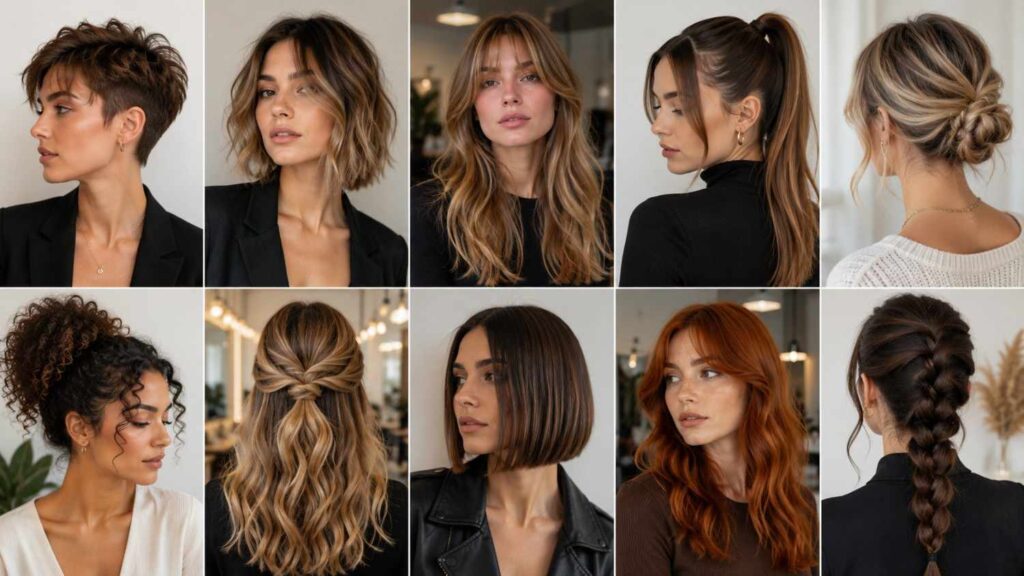
Top 10 Hairstyles for 2026: The Best Hair Trends to Try
The Top 10 Hairstyles for 2026 reflect a wider movement toward hair that looks considered without appearing overly controlled. Clean lines, shine, and polished styling remain important, but many of the year’s most wearable cuts also allow natural movement, softness, and individual texture to remain visible.
Several leading beauty publications have identified a combination of nostalgic and modern influences. Vogue’s annual forecast highlights side fringes, sculptural curls, polished blowouts, and elegant finishes influenced by the 1990s and early 2000s. Allure’s seasonal reports add modern shags, collarbone lengths, soft sculpted bobs, waterfall hair, bixies, curly wolf cuts, and ’70s feathering. Elle and Byrdie similarly emphasize lightness, adaptability, softer bobs, mobile fringe, and cuts that can work with real-life styling routines.
These trends should be treated as flexible design directions rather than fixed templates. A haircut shown on straight, medium-density hair may require a different perimeter or layering strategy when recreated on fine waves, dense curls, or tightly coiled hair. Length can also appear different after shrinkage, air-drying, or changes in styling.
In my experience, the most successful haircut conversations begin with function rather than fashion. Consider how often you wash your hair, whether you normally air-dry or blow-dry, how much time you want to spend styling, and how frequently you can maintain the shape.
The sections below explain what defines each trend, who may benefit from it, what to ask for at the salon, and which maintenance factors deserve attention before making a significant change.
What Defines the Biggest 2026 Hairstyle Trends?
The most important 2026 hairstyle trends are not connected by a single length or texture. Instead, they share a broader design philosophy: hair should look intentional while remaining compatible with everyday life. Some styles use strong perimeters and glossy finishes, while others depend on airy layers, curls, movement, or a deliberately relaxed shape. The common objective is to create a visible silhouette without making the hair look stiff or overworked.
Current reporting shows two influences developing at the same time. The first is a return to polished styling inspired by the 1990s and early 2000s. This includes side parts, smooth bobs, blowouts, chignons, controlled shine, and carefully shaped curls. The second influence is a movement toward lower-effort styling, natural texture, softer edges, and haircuts that continue to look attractive when they are not professionally finished.
These directions are not contradictory. A haircut can have a precise outline while still moving naturally. A curly shape can appear polished without requiring every curl to be identical. A shag can retain texture while using more carefully blended layers than heavily disconnected versions from previous trend cycles.
The practical lesson is that the cut and finish should support each other. Strong geometric styles depend on perimeter maintenance, while layered styles depend on correct weight distribution. Curly and coily shapes require careful consideration of shrinkage and volume placement. Understanding these principles will help you distinguish a genuinely suitable trend from a style that only works under professional lighting and intensive preparation.
Many of this year’s defining styles align with Vogue’s 2026 hair trend forecast, which highlights polished finishes, soft movement, and personalized styling over one-size-fits-all cuts.
Polished Hair Without a Rigid Finish
Polished hair in 2026 is less about forcing every strand into an immovable position and more about creating controlled shape, reflective shine, and a purposeful finish. Vogue’s trend forecast describes a renewed interest in sleek, elegant hair influenced by 1990s and early-2000s styling, while Elle’s seasonal coverage emphasizes softness, movement, and natural texture. Together, these reports suggest that refinement and flexibility can exist in the same hairstyle.
For a bob, this may mean smoothing the surface while allowing the ends to curve or separate naturally. For long hair, it may involve a clean center or side part with brushed waves rather than a heavily sprayed finish. Curly hair can achieve the same polished quality through a well-defined silhouette, controlled frizz where desired, and healthy-looking hydration.
Product selection should support the hair rather than overwhelm it. Lightweight creams, mousses, flexible gels, heat protectants, and small amounts of finishing oil may help create control without removing movement. The exact combination depends on texture and density.
The goal is not perfection. It is a style that appears deliberate from different angles and continues to look attractive as it moves throughout the day.
Personalized Cuts for Different Hair Textures
A trend name cannot describe every technical decision required to create a successful haircut. Hair texture, density, porosity, shrinkage, growth patterns, previous chemical services, and styling habits all influence how a shape should be constructed.
For example, a soft sculpted bob may require a relatively clean perimeter on fine or medium-density straight hair. On dense curls, the same overall concept may need rounded layering, internal weight removal, and carefully preserved length in areas that support the silhouette. Allure’s 2026 guidance specifically notes that denser, curlier hair can achieve a sculpted bob through rounded layers that release weight while building shape.
Personalization is equally important with fringes and layered cuts. A strong cowlick may alter where a side fringe naturally falls. Fine hair may lose visible density when excessively layered. Tight curls can appear significantly shorter after drying, which means the stylist must account for shrinkage before determining the final length.
A professional consultation should therefore include more than showing one reference photograph. Discuss how you normally wear your hair, how much heat styling you use, and what the cut should look like when air-dried.
The objective is not to reproduce another person’s hair exactly. It is to translate the trend into a version that behaves predictably on your own texture.
| Hairstyle Trend | Hair Length | Key Feature | Styling Finish | Trend Focus |
|---|---|---|---|---|
| Nordic Bob | Short | Blunt perimeter | Glossy | Minimalist look |
| Soft Sculpted Bob | Short | Soft movement | Polished | Flexible styling |
| Bixie | Short | Pixie + Bob blend | Textured | Modern hybrid cut |
| Collarbone Lob | Medium | Balanced length | Natural | Everyday versatility |
| Modern Shag | Medium | Layered volume | Air-dried texture | Relaxed movement |
| Waterfall Hair | Long | Smooth flowing length | Satin finish | Healthy shine |
| Curly Wolf Cut | Medium | Layered curls | Natural curls | Defined texture |
| Feathered Layers | Medium-Long | Face-framing layers | Bouncy | Retro-inspired volume |
| Side Fringe | Any Length | Deep side part | Soft | Face-framing update |
| Sculptural Curls | Any Length | Structured curl shape | Defined | Natural curl enhancement |
Best Short Hairstyles for 2026
Short hair remains one of the most visible directions within the Top 10 Hairstyles for 2026, but the category includes more variety than a single conventional bob. Some of the year’s leading short cuts use blunt perimeters and minimalist lines, while others introduce soft layering, longer fringe, movement around the ears, or a deliberately relaxed finish.
The continued popularity of short hair reflects both aesthetic and practical appeal. A strong short silhouette can make an immediate visual impact, emphasize the neckline, and create the appearance of healthier or fuller ends. However, short does not automatically mean low-maintenance. Precise bobs and cropped hybrid cuts often require more frequent reshaping than long hair because small changes in length can alter the entire outline.
Current trend reports repeatedly feature bobs, bixies, chin-grazing shapes, and softer short cuts. Vogue has documented the continued influence of celebrity bobs and the growing interest in the Nordic bob. Allure, Elle, and Byrdie have highlighted soft sculpted bobs, airy bobs, bixies, heartthrob-inspired short cuts, and deliberately undone variations.
When selecting a short hairstyle, examine where the perimeter will fall in relation to the chin, jaw, ears, and neckline. Also consider how the hair behaves around the crown and temples. A stylist may need to adjust the length to accommodate cowlicks, curl shrinkage, or density.
The following three styles provide distinct options: the precise Nordic bob, the flexible sculpted bob, and the softer bob-pixie hybrid known as the bixie.
1. The Nordic Bob
The Nordic bob is a chin-length or jaw-grazing cut defined by a clean perimeter, limited layering, and a minimalist silhouette. It is commonly associated with a deep side part, which can introduce lift and prevent the shape from appearing overly severe.
Vogue reported substantial growth in interest in the Nordic bob during summer 2026 and described it as a style that can make fine hair appear thicker through its blunt ends. Elle has also covered the closely related Scandi bob, emphasizing crisp lengths, subtle movement, and understated shine.
The cut can be especially effective for fine or medium-density hair because preserving weight at the perimeter creates a stronger visual edge. On thicker or textured hair, the stylist may need to remove internal bulk without weakening the external line.
Ask for a chin-grazing length, a relatively solid perimeter, and long or minimal internal layering. Discuss whether a side or center part works best with your natural growth pattern.
The Nordic bob may require little complicated daily styling, but maintaining its graphic shape usually involves regular trims. It is best suited to someone who values a clean outline and is willing to protect that outline from becoming uneven as the hair grows.
2. The Soft Sculpted Bob
The soft sculpted bob offers a more flexible alternative to an extremely blunt or geometric cut. Its silhouette remains intentional, but the ends and internal shape allow enough movement to prevent the hair from appearing heavy, rigid, or triangular.
Allure identifies the soft sculpted bob as one of spring 2026’s leading haircut directions. The publication’s stylist guidance explains that the shape can be customized across textures, including rounded layers for denser curls that release weight while maintaining a soft, dome-like outline.
For straight or lightly wavy hair, the cut may feature a clean perimeter with restrained internal layering. For curly hair, shaping can be more visible, with shorter areas providing lift and longer sections preserving weight. The stylist should determine where movement is needed rather than thinning the hair uniformly.
This bob is a practical choice for someone who appreciates a polished short cut but does not want to depend on a completely smooth blowout. It can be worn sleek, softly waved, tucked behind the ears, or styled around natural curls.
Ask your stylist how the shape will look when air-dried and whether the proposed layering will affect density at the ends. A successful sculpted bob should remain recognizable even when the finish changes.
3. The Bixie
The bixie combines elements of a bob and a pixie. It is generally shorter and lighter than a conventional bob but retains more length around the crown, fringe, ears, or neckline than a closely cropped pixie. This hybrid structure gives the wearer several styling possibilities while still delivering the impact of a short haircut.
Allure includes the bixie among its leading summer 2026 haircut trends, while Elle and Byrdie describe related short styles that prioritize movement, softness, and an intentionally relaxed finish.
The bixie can work particularly well for people who want to experiment with short hair without committing to a very exposed crop. Longer fringe can be swept to the side, separated into texture, or styled away from the face. Crown layers can create lift, while pieces around the ears soften the transition between a bob and pixie.
Maintenance depends on the precision of the cut. A loose, layered bixie may grow out more gracefully than a highly sculpted version, but both require periodic reshaping around the neckline and ears.
Before cutting, ask the stylist to explain the grow-out plan. Understanding which sections will become heavy or lose shape can help you schedule future appointments and avoid an awkward transition.
Best Medium and Long Hairstyles for 2026
Medium and long hairstyles in 2026 are being defined by clearer silhouettes, controlled movement, and more thoughtful use of layers. Length alone is no longer treated as the complete style. Instead, the perimeter, face framing, internal weight, parting, and finishing method work together to create a recognizable shape.
Medium-length hair remains especially versatile because it can be worn down, tied back, curled, straightened, or incorporated into a simple updo. Collarbone and shoulder lengths also provide a practical transition for someone growing out a bob or considering a shorter cut without committing immediately.
Longer styles are moving in two directions. Some use soft, face-framing layers to create bounce and visual movement. Others preserve a heavier, cleaner outline and rely on styling rather than extensive layering. Allure’s spring and summer reports identify shoulder-length cuts, collarbone lobs, modern shags, waterfall hair, feathered layers, and extra-long styles as important 2026 directions. Byrdie also highlights longer 1990s-inspired layers and adaptable mid-length shapes.
Maintenance remains an important consideration. Long hair may need fewer shape-focused salon visits than a precise bob, but it can require more time for cleansing, conditioning, drying, detangling, and heat styling. Heavily layered hair may provide movement but can also reduce fullness at the ends if the layers are not planned carefully.
The collarbone lob, modern shag, and waterfall style represent three different approaches. The lob emphasizes flexibility, the shag uses layering and texture, and waterfall hair creates impact through uninterrupted length and a smooth perimeter.
4. The Collarbone Lob
The collarbone lob sits between a traditional bob and long hair, usually falling near the collarbone or upper shoulder. This placement provides enough length for ponytails and simple updos while retaining the freshness and visible shape of a shorter haircut.
Allure’s 2026 trend reporting identifies collarbone and shoulder-length cuts as versatile options that can be supported by internal shaping and a perimeter that appears substantial without becoming harsh.
The lob can be customized in several ways. A straighter, denser texture may benefit from restrained internal layers that prevent the ends from appearing block-like. Fine hair may look fuller with a stronger perimeter and minimal layering. Wavy or curly hair may need strategic shaping to prevent excessive width around the shoulders.
This is a practical option for someone who wants a noticeable update but still relies on tying the hair back. It also works as a transitional style when growing out a short bob or gradually removing damaged length.
Ask the stylist where the cut should sit when dry, particularly if your hair has significant wave or curl. The exact collarbone position can change after shrinkage or styling.
A well-designed lob should offer several wearable finishes rather than looking complete only after a professional blowout.
5. The Modern Shag
The modern shag retains the movement, crown volume, and personality associated with traditional shag haircuts but replaces extremely disconnected or heavily razored sections with softer, more controlled layering. The result is easier to adapt to different textures and professional environments.
Allure’s spring 2026 report describes the current shag as floatier and more romantic, often supported by curtain-style or mobile fringe. Byrdie similarly identifies soft shags and organic texture as central elements of spring haircut trends.
The success of this cut depends on layer placement. Fine hair may require longer, fewer layers to preserve density. Thick straight hair may benefit from internal weight removal. Wavy and curly textures can use shorter crown layers to encourage movement, but excessive layering may create unwanted width or reduce definition.
A modern shag can be air-dried, diffused, waved, or styled with a rounded brush. That flexibility makes it appealing to people who want visible movement without maintaining a sharp perimeter.
When discussing the cut, describe how much volume you want at the crown and how short you are willing to make the face-framing pieces. Ask the stylist to explain how the shortest layers will behave when the hair is not styled.
The aim should be controlled movement, not random thinning.
6. Waterfall Hair
Waterfall hair is a long, smooth style characterized by a relatively clean perimeter, deliberate shine, and waves that flow through the length in broad, satin-like sections. Unlike heavily layered cuts, its visual impact comes from continuity and the impression of uninterrupted movement.
Allure’s spring 2026 forecast describes waterfall hair as long, primarily one-length hair styled into smooth ripples, offering a softer alternative to a highly voluminous blowout.
This look is most convincing when the ends remain healthy enough to support a strong outline. Split or heavily thinned ends can interrupt the visual flow. Regular conditioning, careful detangling, heat protection, and periodic trimming therefore matter as much as the final styling technique.
Waterfall hair does not necessarily require completely straight texture. Natural waves can support the effect when the cut preserves enough length and weight. Curly hair may achieve a related result through stretched or defined styling, although the finished silhouette will differ from the editorial examples.
Before committing to the look, consider whether your current length and density can create the desired perimeter. Extensions may be used in editorial styling, but they should not be assumed to be necessary.
Ask for minimal disruption to the outline and discuss whether subtle internal shaping is needed to prevent heaviness without creating obvious layers.
Related Articles
Best Layered and Textured Hairstyles for 2026
Layered and textured hairstyles are becoming more intentional in 2026. Instead of using layers simply to remove bulk, stylists are using them to determine where volume begins, how the hair moves around the face, and whether curls expand upward, outward, or downward.
This approach is particularly important for wavy, curly, and coily hair. Texture can change significantly after drying, which means the final shape cannot always be predicted from wet length alone. Shrinkage, curl grouping, density, and the distribution of weight all affect the silhouette. A successful textured cut should work with these characteristics rather than treating them as problems to be corrected.
Current reports show a renewed interest in decades associated with visible volume and movement. Allure’s summer forecast includes curly wolf cuts and ’70s feathering, while Vogue points toward sculptural curls and polished, intentional styling. Byrdie also identifies organic curls, soft shags, and long 1990s-style layers as part of the year’s broader direction.
Layered cuts can be highly adaptable, but they should not be described as universally low-maintenance. Some textures will fall naturally into the intended shape after air-drying. Others may need diffusing, brush styling, rollers, or heat tools to emphasize the movement shown in reference images.
The curly wolf cut and ’70s feathered layers represent two different ways to create volume. The wolf cut relies on separation, crown lift, and texture. Feathered layers create controlled movement around the face and often depend on a sweeping, outward finish.
7. The Curly Wolf Cut
The curly wolf cut combines shag-inspired layering with a fuller crown, shorter face-framing sections, and lighter lengths. Its structure is designed to encourage visible movement and prevent curls from forming one heavy, uniform shape.
Allure includes the curly wolf cut in its summer 2026 trend report, connecting the style to the return of 1980s-inspired volume and expressive texture.
The cut must be customized carefully. Loose waves may need shorter crown layers to create lift, while tighter curls may require more length to account for shrinkage. Dense hair may benefit from selective internal weight removal, but aggressive thinning can disrupt curl formation or produce frizz.
Bring reference photographs showing a curl pattern and density similar to your own. Images of straightened or professionally extended hair may not provide realistic guidance for how the shape will behave after washing.
Ask the stylist whether the cut will be performed wet, dry, or through a combination of methods. Different professionals use different techniques, and the most appropriate choice depends on the consistency of your curl pattern and the desired result.
The wolf cut is best for someone who welcomes visible texture and volume. It may not suit a person who prefers all layers to fall into a smooth, uniform outline.
8. ’70s Feathered Layers
’70s feathered layers create movement through face-framing sections that sweep away from the face. The style can range from subtle, wearable layering to a dramatic full blowout with noticeable lift and outward movement.
Allure’s summer 2026 coverage identifies feathering as part of the year’s return to decade-inspired hair, while Vogue’s broader trend forecast supports the renewed interest in polished blowouts and intentional volume.
The haircut should be designed around the wearer’s regular styling habits. Someone who frequently uses a round brush, rollers, or a heated styling brush may benefit from more visible face-framing layers. A person who normally air-dries may need longer, softer sections that still blend naturally without being shaped outward.
Fine hair requires caution because too many short layers can reduce density through the lengths. Thick hair may accept more layering, but the stylist should preserve enough weight to prevent the ends from appearing thin.
Ask where the shortest face-framing piece will fall and whether it can still be tucked behind the ear or tied back. This small practical detail often determines whether the cut feels manageable.
This approach also reflects broader summer hairstyle trends, where lightweight layers and effortless movement continue to dominate seasonal salon requests.
A successful feathered style should retain a pleasing outline even after the dramatic blowout has softened.
Best Fringe and Curl Styling Trends for 2026
Not every hairstyle update requires removing substantial length. Changing the parting, fringe, curl placement, or overall silhouette can make an existing haircut feel current while preserving most of the hair.
This is one reason side-swept fringe and sculptural curls are important within the 2026 hairstyle conversation. Both trends focus on arrangement rather than one mandatory length. A side fringe can be added to a bob, lob, shag, blowout, ponytail, or long layered cut. Sculptural curls can appear in cropped, shoulder-length, or long styles as long as the haircut supports a deliberate shape.
Vogue’s annual forecast identifies side fringes and sculptural curls among the year’s central trends. Its spring reporting also documents the return of the side part across sleek hair, wet-look finishes, natural curls, bobs, blowouts, and low updos. Allure’s coverage of 2026 fringe trends similarly points toward bolder, more personalized bangs, including airy curly options.
These changes may appear less permanent than a major haircut, but they still require planning. Fringe interacts with the hairline, cowlicks, forehead, and daily styling routine. Sculptural curls depend on volume placement, moisture balance, product application, and the shape created by the cut.
Before making either change, test the idea temporarily where possible. Move your part for several days or pin the front sections into a simulated fringe. For curls, experiment with different drying positions and partings to understand where natural volume develops.
9. Side-Swept Fringe and Deep Side Parts
Side-swept fringe and deep side parts are among the clearest styling shifts of 2026. They introduce asymmetry, create movement around the face, and can make an existing haircut feel noticeably different without requiring a dramatic loss of length.
Vogue identifies side fringes as a central 2026 trend and has documented the return of the side part across polished blowouts, bobs, natural curls, wet-look styles, and low buns. The publication notes that the placement can make a hairstyle feel more deliberate and glamorous.
A side fringe should be adapted to the natural hairline. Strong cowlicks may cause shorter pieces to lift or separate unexpectedly. Curly fringe must be cut with shrinkage in mind, while fine hair may need a lighter section to avoid removing too much density from the rest of the style.
Before cutting, move your part at home and observe how the hair falls after washing. This will reveal whether the new direction feels comfortable and whether additional styling is required.
Ask the stylist how the fringe will grow out and whether it can be tucked behind the ear. Longer side-swept sections usually provide more flexibility than a short, fixed bang.
The trend is most successful when the fringe looks connected to the overall haircut rather than added as a separate element.
10. Sculptural Curls
Sculptural curls emphasize the overall silhouette of the hair rather than requiring every curl to look identical. Volume may be concentrated at the crown, around the sides, through the fringe, or along the perimeter, depending on the desired shape and natural curl pattern.
Vogue includes sculptural curls in its 2026 trend forecast, placing them within a wider movement toward intentional, polished hair. Allure’s natural-hair reporting also highlights approaches that prioritize texture, lower tension, and shapes such as finger coils, fluffy finishes, and textured short cuts.
The haircut is central to the result. Styling products can define curls and control expansion, but they cannot fully correct an unsuitable distribution of weight. A stylist should determine where length is needed to preserve the outline and where layers can create lift.
Product application should support the preferred shape. Applying gel or cream in sections may create more consistent definition, while diffusing in a particular direction can influence volume. Some people prefer a controlled exterior with softer internal texture; others want maximum expansion.
Ask how the cut will look at different stages of the wash cycle. Curls may become larger, softer, or less defined over several days, so the silhouette should remain attractive beyond the first styling session.
How to Choose the Right 2026 Hairstyle
The most fashionable haircut is not automatically the most suitable haircut. Before selecting from the Top 10 Hairstyles for 2026, consider how the style will behave during an ordinary week rather than evaluating it only through a professionally styled editorial image.
Begin with your natural texture and density. Fine straight hair, dense waves, loose curls, and tight coils respond differently to blunt perimeters, internal layers, fringe, and short crown sections. The same written haircut request can create dramatically different results when those variables change.
Next, consider maintenance. Short hair may take less time to wash, but precise outlines often require frequent salon visits. Long hair can go longer between major reshaping appointments, yet it may demand more detangling, conditioning, and drying time. A fringe can transform a style without changing the overall length, but it may require regular trimming and daily attention.
Your normal styling routine is equally important. A haircut designed around a rounded-brush blowout may not look the same when air-dried. A curly wolf cut may perform beautifully with diffusing but appear different when stretched or tied back. There is no problem with choosing a style that requires effort, provided that effort matches your expectations.
Reference photographs should guide the consultation rather than replace it. Look for models with similar texture, density, and current length. Ask the stylist to explain which parts of the reference are realistic and what modifications are necessary.
The best result is not an exact copy. It is a technically appropriate interpretation that still delivers the movement, outline, or mood you originally liked.
| Hairstyle | Best Hair Type | Maintenance Level | Styling Time | Best For |
|---|---|---|---|---|
| Nordic Bob | Fine, Straight | High | Low | Fuller-looking short hair |
| Soft Sculpted Bob | Straight, Wavy, Curly | Medium | Low-Medium | Soft polished finish |
| Bixie | Fine, Medium | Medium | Low | Modern short haircut |
| Collarbone Lob | Straight, Wavy | Medium | Medium | Versatile everyday styling |
| Modern Shag | Wavy, Thick | Medium | Low | Natural texture and movement |
| Waterfall Hair | Straight, Long | Medium-High | Medium-High | Sleek long hairstyles |
| Curly Wolf Cut | Curly, Coily | Medium | Medium | Defined volume and shape |
| Feathered Layers | Medium, Thick | Medium | Medium | Face-framing movement |
| Side-Swept Fringe | All Hair Types | Low | Low | Quick style refresh |
| Sculptural Curls | Curly, Coily | Medium | Medium | Structured curl definition |
Compare Texture, Density, and Maintenance
One thing I always recommend is evaluating texture, density, and maintenance together rather than treating them as separate concerns. These factors determine both how the haircut is constructed and how much work it requires after the salon appointment.
Start by observing your hair when it is freshly washed and allowed to dry with minimal manipulation. Note where it expands, becomes flat, forms curls, separates, or develops frizz. This gives the stylist more useful information than describing your hair only as thick, thin, straight, or curly.
Next, consider density. Fine strands can still be dense, while coarse strands may be relatively sparse. A blunt perimeter can make some types of fine hair appear fuller, but excessive internal layering may reduce the visual weight of the ends. Dense curls may need strategic weight removal, although indiscriminate thinning can damage the shape.
Finally, define your maintenance limits. Decide how frequently you can visit the salon and how many minutes you realistically spend styling each day. A Nordic bob may have a simple daily routine but need consistent trims. A shag may grow out softly but require product or diffusing to emphasize its texture.
Share these limits honestly. A professional stylist can usually adapt a trend more successfully when the practical expectations are clear.
Take Useful Reference Photos to the Salon
Reference photographs are most helpful when they communicate specific features rather than an unrealistic demand for exact duplication. Bring two or three images showing the outline, fringe, layer placement, or styling effect you like.
Choose references with hair that resembles your own in texture, density, and starting length. A photograph of a heavily extended or professionally straightened style may not explain how the haircut will behave on your natural hair. Similarly, a curly cut shown immediately after salon styling may appear different several days into the wash cycle.
During the consultation, identify what you like in each image. You may prefer the first photograph’s fringe, the second image’s perimeter, and the third example’s volume. This gives the stylist a clearer design brief than simply saying you want the entire look.
Ask what styling was probably used to produce the reference. A smooth bob may depend on heat styling, while feathered layers may need a round brush or rollers. Understanding that process helps you decide whether the result suits your routine.
It is also useful to bring one image showing what you do not want. Explain whether you want to avoid excessive volume, thin-looking ends, short crown layers, or a fringe that cannot be tied back.
Quick Answer About Top 10 Hairstyles for 2026
The Top 10 Hairstyles for 2026 combine polished outlines with softer movement, natural texture, and more flexible styling. The most notable choices include the Nordic bob, soft sculpted bob, bixie, collarbone lob, modern shag, waterfall hair, curly wolf cut, ’70s feathered layers, side-swept fringe, and sculptural curls.
Current beauty reporting shows that bobs remain especially influential, but the newer versions are not limited to one blunt or highly controlled shape. Airier finishes, rounded layers, lived-in movement, deep side parts, and cuts designed around natural texture are becoming equally important. Long and medium styles are also being refreshed through intentional perimeters, face-framing layers, and retro-inspired volume.
The best choice depends on more than what looks fashionable in a photograph. Hair density, curl pattern, shrinkage, growth direction, daily styling time, and salon maintenance all affect how a cut performs. A blunt Nordic bob may help fine hair appear fuller, while dense curls may benefit from a rounded bob or carefully planned internal layers. Long waterfall hair creates a polished effect through length and a strong perimeter, whereas a shag or wolf cut relies more heavily on texture and separation.
Use this guide to identify the shape you like, then ask a qualified hairstylist to adapt its length, weight, fringe, and layering to your individual hair.
Frequently Asked Questions About Top 10 Hairstyles for 2026
Questions about current hairstyles usually involve more than identifying what appears fashionable. Readers also want to know whether a trend will work with fine, thick, straight, wavy, curly, or coily hair; how much maintenance it requires; and what language to use during a salon consultation.
The answers below address these practical concerns while recognizing that trend forecasts are editorial rather than universal rules. A hairstyle can be highly visible in magazines, on runways, or across social platforms without being the correct choice for every person. Hair health, density, growth patterns, lifestyle, and professional requirements remain more important than following a trend exactly.
It is also helpful to distinguish between a haircut and a finish. A side part or polished blowout can update several different haircuts. Sculptural curls depend on both the underlying shape and the styling method. A bob may be cut blunt, softened internally, rounded for curls, or layered for movement while still belonging to the same general category.
Current sources consistently support the continued popularity of bobs, bixies, collarbone cuts, modern shags, waterfall lengths, retro feathering, wolf-inspired curls, side fringe, and deliberate curl shapes.
Use the following answers as preparation for a professional consultation. A stylist who can examine your hair in person will be better positioned to determine the exact length, perimeter, layer placement, and maintenance schedule required.
What hairstyle is most popular in 2026?
There is no single hairstyle that can be proven to be the most popular across every country, age group, platform, and hair texture. However, bobs remain especially visible in 2026 trend reporting, with variations including Nordic, Scandi, soft sculpted, airy, chin-grazing, Hollywood, inward-curved, and boy bobs.
Short hybrid cuts such as the bixie are also prominent, while collarbone lobs, modern shags, waterfall hair, curly wolf cuts, feathered layers, side fringes, and sculptural curls provide strong alternatives. Vogue, Allure, Elle, and Byrdie have all included several of these shapes in their 2026 coverage.
The most relevant trend for an individual depends on the desired length and level of styling commitment. Someone with fine hair may value a strong bob perimeter, while a person with dense curls may prefer rounded layering or a wolf-inspired shape.
Rather than choosing the style mentioned most frequently, select the trend whose underlying structure matches your hair and routine. Popularity can provide inspiration, but suitability determines whether the result remains wearable after the first salon styling.
Are bob haircuts still fashionable in 2026?
Yes. Bob haircuts remain highly influential in 2026, but the category has expanded beyond one classic blunt shape. Current versions include clean Nordic and Scandi bobs, soft sculpted bobs, airy bobs, boy bobs, inward-curled 1990s-inspired bobs, and other chin- or jaw-length variations.
Vogue has documented the continued presence of celebrity bobs and growing interest in Nordic styling, while Allure, Elle, and Byrdie have highlighted both structured and softened versions.
The most appropriate version depends on texture and density. Fine hair may benefit from a clean perimeter that preserves visual fullness. Thick straight hair may need internal weight removal. Curly hair can be shaped into a rounded or sculpted bob with layers designed around shrinkage and volume.
Maintenance also varies. A highly precise jaw-length bob may need frequent trimming, while a softer or slightly longer version can tolerate more growth.
Ask your stylist to recommend the bob category that best matches your normal styling method. The trend remains fashionable because it can be adapted, not because everyone is wearing exactly the same cut.
Which 2026 hairstyle is best for fine hair?
A blunt or minimally layered bob is often a strong option for fine hair because preserving weight at the perimeter can make the ends appear fuller. The Nordic bob is particularly relevant because its clean, chin-length outline is designed around a substantial edge rather than heavily separated layers.
Vogue’s current Nordic bob coverage specifically notes its ability to create the impression of thicker hair through blunt ends.
A collarbone lob can also work well when the wearer wants more length. The stylist may use restrained internal shaping to create movement without removing too much visible density. Soft face framing can be added, but the shortest layers should be planned carefully.
Fine hair does not always mean low density, so a professional should evaluate the number of strands as well as their thickness. Some fine hair can support more layering than expected, while sparse ends may need a stronger outline.
Avoid requesting extensive thinning solely because a reference image looks airy. That effect may have been produced through styling rather than cutting.
The best choice will create enough movement to avoid flatness while preserving sufficient weight through the perimeter. Ask how the proposed layers will affect fullness when the hair is air-dried.
What is a good 2026 hairstyle for curly hair?
The curly wolf cut, rounded sculpted bob, modern curly shag, side-swept curly fringe, and sculptural curl shape are all relevant options for 2026. The most suitable choice depends on curl pattern, density, shrinkage, preferred volume, and how the hair changes between wash days.
Allure’s reporting includes curly wolf cuts, rounded sculpted bobs, and natural-hair trends that prioritize texture and lower-tension styling. Vogue also identifies sculptural curls as an important direction.
A curly wolf cut works well for someone who wants crown lift, separation, and visible movement. A rounded bob provides a more contained silhouette. Sculptural curls are appropriate when the overall shape matters more than uniform curl definition.
Choose a stylist who regularly works with hair similar to yours. Bring photographs showing a comparable curl pattern and density, and ask whether the hair will be cut wet, dry, or through a combined process.
Discuss shrinkage before agreeing on the shortest layer or fringe. The final dry length may be substantially different from the wet length, especially around the face and crown.
Are side parts coming back?
Yes. Side parts and side-swept fringes are clearly present in 2026 hairstyle reporting. Vogue identifies side fringe as one of the year’s broader trends and has documented side parts across smooth blowouts, natural curls, wet-look styling, bobs, and low updos.
The current version is flexible rather than limited to one sharply defined line. Some styles use a dramatic deep side part to create lift and asymmetry, while others rely on a softer off-center placement. The direction can be paired with short, medium, or long hair.
A side part is also one of the easiest trends to test before making a permanent change. Move your part after washing and wear it for several days. Observe whether the hair stays in place, develops volume, or fights against a cowlick.
When adding side-swept fringe, consider how much hair must be separated from the main style. Fine hair may require a lighter fringe to preserve density elsewhere.
The return of the side part does not mean center parts are outdated. Both remain wearable. The more useful question is which placement supports your haircut, growth pattern, and preferred level of volume.
What should I ask my hairstylist before changing my haircut?
Begin by asking how the proposed haircut will behave when styled in the way you normally wear your hair. A cut that looks ideal after a professional blowout may perform differently when air-dried, diffused, tied back, or exposed to humidity.
Ask how frequently the shape needs trimming and which areas will lose their form first. Precise bobs may require closer maintenance around the perimeter, while layered cuts may grow out more gradually.
Discuss the products and tools required to reproduce the finish. Request a realistic routine rather than a long list of optional products. A stylist should be able to explain whether the look depends on a round brush, diffuser, flat iron, curling tool, rollers, or simple air-drying.
Also ask whether the reference photograph reflects your texture and density. Invite the stylist to recommend modifications instead of insisting on an exact copy.
For curly or coily hair, discuss shrinkage, dry length, volume placement, and the preferred cutting method. For fringe, ask how it will grow out and whether it can be pinned or tucked away.
Finally, request a clear styling demonstration before leaving. Understanding the technique is often more valuable than receiving a perfect salon finish that cannot be recreated at home.
Conclusion
The Top 10 Hairstyles for 2026 demonstrate that the year’s most relevant hair trends are not limited to one texture, length, or styling philosophy. Short options such as the Nordic bob, soft sculpted bob, and bixie provide strong silhouettes with different levels of structure and movement. Medium and long styles—including the collarbone lob, modern shag, and waterfall hair—offer flexibility without treating length as the only defining feature.
Texture-focused options are equally important. The curly wolf cut creates volume and separation, while ’70s feathered layers introduce face-framing movement and retro polish. Side-swept fringe can update an existing cut without removing substantial length, and sculptural curls place the overall silhouette at the center of the style.
The most important lesson is that trend names are starting points rather than technical instructions. Hair texture, density, porosity, shrinkage, growth patterns, daily routine, and salon schedule all influence how a cut should be adapted. A style that looks effortless may still depend on specific layering, heat styling, product application, or regular maintenance.
Choose references that resemble your natural hair and explain which details matter most to you. Ask the stylist how the cut will perform when air-dried, how it will grow out, and what is required to recreate the finish at home.
The strongest 2026 hairstyle will not simply look current on the day of the appointment. It will continue to support your hair, routine, and personal style during ordinary daily wear.